



460VAC Conveyor Systems
High Torque. Long Runs. Continuous Duty.
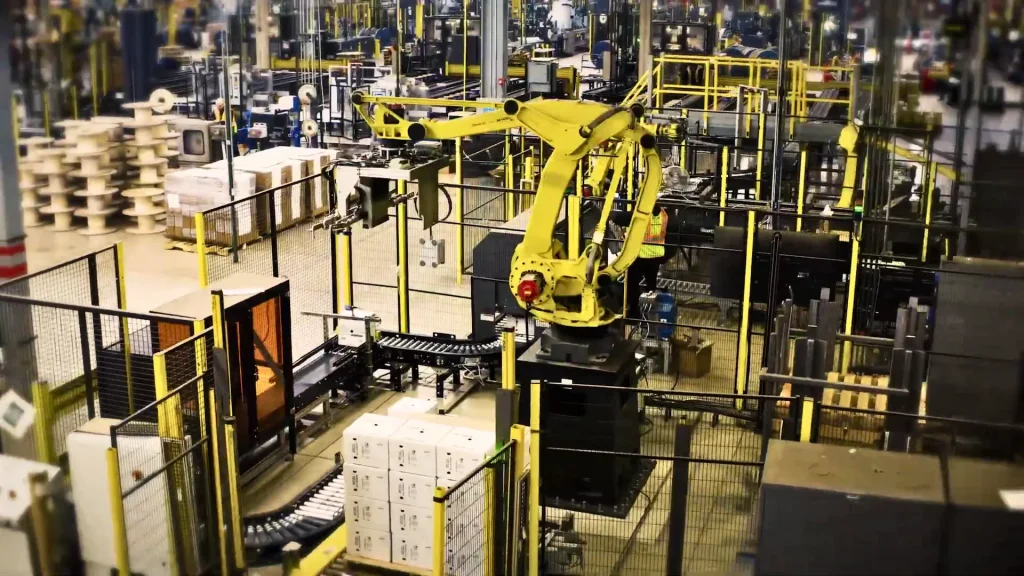
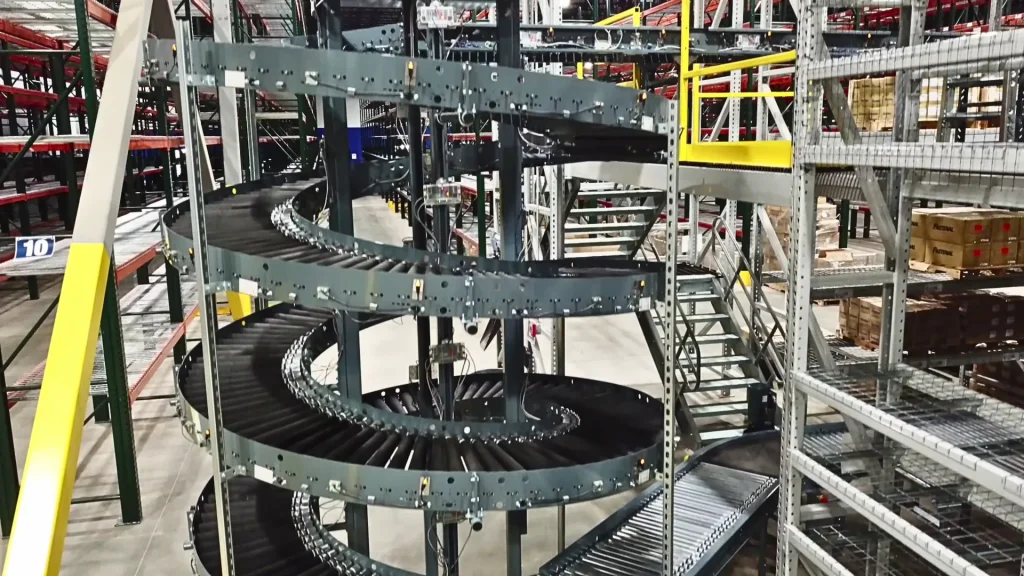
Facility Functions, Inc. designs, installs, and modernizes 460VAC conveyor systems built for heavy loads, long conveyor runs, and 24/7 duty cycles. 24VDC MDR is our core specialty, and it’s where our engineering and fabrication live entirely in-house. For 460VAC, we design and build the mechanical system — frames, conveyor beds, structural steel — in the same shop, and partner with specialized controls integrators for panel build and PLC programming.
Why 460VAC
460VAC conveyor uses three-phase AC motors — nameplate-rated at 460V to run on standard 480VAC facility power — to drive rollers, belts, or chains at constant speed, or through a variable frequency drive (VFD) for adjustable speed control. It’s the long-standing industrial standard for moving heavy material over long distances, and it’s still the right call in a specific set of conditions.
Heavy Loads, Long Runs
A centrally-driven AC motor delivers the torque needed to move heavy unit loads over conveyor runs of hundreds of feet or more — a distance and weight combination where distributed 24VDC rollers aren’t the right fit.
Continuous Duty
Where a line runs 24/7 at high, steady volume, a centralized AC drive is built for exactly that: constant operation without the zone-by-zone start-stop logic that 24VDC MDR is optimized around.
Centralized Control
A single PLC governing the whole line makes sense when the priority is synchronized, plant-wide operation rather than independent zone logic — bulk material handling and long production lines are the clearest examples.
Environmental Hardening
460VAC systems support explosion-proof motors, custom belt materials for chemical or high-temperature exposure, and washdown or stainless construction — configurations common in hazardous, high-heat, or hygienic environments.
Available configurations include VFDs for speed control and energy optimization, explosion-proof motors, custom belt materials, integrated safety guards and e-stops per OSHA/ANSI standards, and custom paint or stainless finishes for corrosion resistance or hygiene requirements.
Technical Specifications
| Spec | Range |
|---|---|
| Motor horsepower | 1/3 HP to 10 HP standard, higher available |
| Rated load capacity | lbs per foot or per zone, and max unit load |
| Belt/roller speed | FPM range |
| Frame construction | steel gauge, aluminum options, etc |
| Noise level at operating speed | dB(A) — the MDR page cites 75-85 dB(A) for "conventional 460VAC" as a comparison point; confirm if that figure is accurate for your actual builds |
| Control panel rating | NEMA 12 / NEMA 4X / UL 508A, etc. |
| Duty cycle rating | continuous, or specific hours/day rating |
Why Build Your 460VAC System with Facility Functions
24VDC MDR is where we specialize today, but 460VAC and lineshaft conveyor is where the company started. Our President spent years in material handling at Rapistan before founding Facility Functions, and much of our early work was built on legacy lineshaft conveyor and 460VAC drive systems — not a technology we picked up recently to round out a product line.
That history is still active, not just a founding story: we continue to supply hard-to-source spare parts for legacy Interlake LS-500 lineshaft conveyor — equipment old enough that most integrators have stopped supporting it.
In practice, this history means:
You should use a 460VAC conveyor system when:
- Operations that require transporting heavy loads over long distances
- The system operates 24/7 with high duty cycles
- Conveyor lines run hundreds of feet or more
- Centralized controls are required for synchronized operations
Industries
Manufacturing & Heavy Industrial
Moving large parts, assemblies, and pallets through continuous production lines — automotive, metalworking, equipment manufacturing.
Mining & Aggregates
Bulk material handling — ore, gravel, crushed stone — built for harsh conditions and long runs.
Agriculture & Bulk Material Handling
Grain, feed, and fertilizer transport across large processing or storage areas, including outdoor and dusty environments.
Food & Beverage Processing
Packaged goods and ingredient transport through multi-stage production, with washdown-compatible construction available.
Recycling & Waste Management
Heavy, mixed-material handling — plastics, metals, paper — in high-impact, debris-heavy conditions.
460VAC Vs. 24VDC MDR
Both product lines typically run on 480VAC facility power — that part is shared. The real difference is what drives the product itself: a 460VAC motor centrally driving the line, versus a 24VDC motor built into each roller, controlling its own zone independently.
| Feature | 460VAC Conveyor | 24VDC MDR Conveyor |
|---|---|---|
| Motor Voltage Rating | 460VAC (NEMA nameplate) | 24VDC |
| Facility Input Power | 480VAC three-phase (typical) | 120VAC or 480VAC, stepped down to 24VDC |
| Typical Use | Heavy loads, long-distance transport, high-throughput continuous lines | Order fulfillment, e-commerce, light-to-medium loads, ZPA, modular zone layouts, high SKU variance |
| Energy Efficiency | Continuous operation regardless of load | Zone-controlled — runs only when occupied |
| Safety | Requires strict lockout/tagout; high-voltage, long drive train | Low-voltage, finger-safe at the roller |
| Noise | High — continuous motor operation and vibration | Low — sealed low-voltage motors, on-demand operation |
| Flexibility | Fixed, centralized drive — layout changes require rewiring and downtime | Modular, zone-based — reconfigure without rewiring the full line |
| Maintenance | Requires licensed electricians; more wear-prone components | Fewer moving parts; zone-level access and replacement |
| Installation | Skilled labor for wiring, conduit, and PLC programming | Minimal wiring; bed-to-bed connections |
| Control Precision | Standard speed control; less precise accumulation | Zero-pressure accumulation, exact product positioning |
| Cost | Higher operating cost from continuous power draw and maintenance labor | Lower total cost of ownership — energy, downtime, and labor combined |
AC conveyor systems commonly run 2–3x the energy of a comparable 24VDC MDR system handling the same throughput, since AC motors draw power continuously regardless of load.
For heavy-duty, long-distance, continuous lines, 460VAC remains the right call — the torque and durability requirement doesn’t go away because MDR is more efficient. For medium-duty, modular, or intermittent lines, 24VDC MDR usually wins on total operating cost. Many facilities run both. See our Case Study for an example of a hybrid system in production.
Considerations Before Choosing a 460VAC Conveyor System
Before choosing a high voltage AC system, it’s important to evaluate your facility’s power infrastructure, load requirements, and operational goals. These systems are best suited for large-scale, continuous operations where high torque and long conveyor runs are necessary. You’ll also need to account for installation costs, electrical safety standards, and maintenance resources.
In many cases, a 24VDC conveyor system can achieve the same throughput with lower energy use, quieter operation, and simpler controls – making it a better fit for modern, flexible facilities.
Energy Consumption
- AC Conveyor Systems consume 2–3x more energy than a comparable 24VDC MDR system handling the same throughput.
- Energy usage increases with conveyor runtime and the weight of the load. Continuous-duty, heavy-load lines can quickly become expensive to operate.
- 24VDC MDR systems use low-voltage motors and distributed drives, meaning only active zones consume power. This makes them much more energy-efficient, especially in facilities with stop-and-start operation or intermittent use.
- For heavy-duty, long-distance, continuous conveyors, AC systems remain the standard due to their torque and durability, but energy costs will be higher.
- For medium-duty, modular, or intermittent conveyors, such as in e-commerce, order fulfillment, or automated sortation lines, 24VDC MDR systems are preferred because they minimize energy waste and reduce operating costs.
Safety
AC conveyors operate on high-voltage power, requiring strict adherence to electrical safety standards. Safety compliance is not a one-time step - it must be considered at every stage to ensure safe operation, reduce risk, and meet regulatory requirements.
To ensure safe operation:
- Emergency stops, safety relays, and interlocks must be properly integrated into the control system.
- Motors and drives should be enclosed or guarded to prevent contact.
- Regular inspections of belts, rollers, and moving parts help prevent pinch-point injuries.
- Training staff on lockout/tagout procedures is essential for maintenance.
- Sensors and photoeyes should be configured to stop the conveyor immediately in case of product jams or unsafe conditions.
Help Me Choose: 460VAC vs. 24VDC MDR
Choose 460VAC for heavy loads, long-distance transport, and continuous operation.
Choose 24VDC MDR for energy efficiency, modularity, precise zone control, and quieter operation.
Choose a hybrid system if your facility needs both — 460VAC where torque and durability matter most, 24VDC MDR where efficiency and zone control matter most. This is common on floors that combine heavy pallet transport with precision accumulation, like assembly or fulfillment lines with a mixed product profile.
Not sure which fits your application? Tell us your product, load, and throughput requirements. We’ll evaluate the application first, then make a straight recommendation — 460VAC, 24VDC MDR, or a hybrid of both — rather than steering you toward whichever we happen to be quoting that week.
What People Say
Ken Hendricks started ABC Supply in 1982 as a small wholesale supplier for area builders. In a short time, he built the company into what would become one of America’s largest roofing and building supply companies. As his company rapidly grew, Ken sought an innovative and trustworthy source to design and install material handling systems that could accommodate ABC Supply’s exploding growth. Ken chose Facility Functions to outfit his distribution centers with then state-of-the-art conveyor and picking systems. ABC and Facility Functions have since worked closely together as both companies continue to grow.
ABC Supply - Distribution Center, Beloit, Wisconsin
Perhaps America’s most iconic brand, Harley-Davidson is also a highly innovative, forward looking company. When it looked for ways to reduce costs, enhance efficiency, and improve worker safety and well-being on its production lines, it selected Facility Functions to design and implement its desired improvements. As a result, Harley-Davidson was one of the first major companies in America to switch from continuous 480 volt AC-powered conveyor systems, to the then newly-devised 24 volt DC on-demand systems. The installation costs alone saved Harley Davidson nearly $5 million, and the operating costs savings experienced by reduced power consumption alone have been significant. In addition, the MDR system reduced noise by as much as twenty decibels, and has measurably reduced hazards associated with high voltage, continuous conveying systems.
Harley Davidson, Inc. - Manufacturing & Distribution, Milwaukee, Wisconsin
Draexlmaier’s South Carolina plant produces a wide variety of components for luxury automotive models - included among those are the dashboards for BMW. With limited available floor space at the Duncan plant, Draaexlmaier sought a way to improve process efficiency and eliminate frequent disruptions caused by mismatched, poorly sequenced inputs - all without needing to acquire additional floor space. They reached out to Facility Functions for assistance where we re-designed an improved production line flow process and added a two-level staging and return accumulator area, that together virtually eliminated production disruptions.
Draexlmaier / BMW Components Plant - Duncan, South Carolina
Lemans has grown into one of the largest distributors of after-market motor cycle and recreational vehicle parts. As the company grew, it too turned to Facility Functions to provide its full material handling system comprised of MDR-powered conveyors, product sorting and picking, and packaging.
Lemans Corporation - Distribution Center, Janesville, Wiconsin
Frequently Asked Questions
What's the difference between 460VAC and 480VAC?
480VAC is the nominal facility power delivered to your building. 460VAC is the standard NEMA nameplate rating for motors designed to run on that 480V supply — the two aren’t competing options, they describe the same system at two different points. When we say “460VAC conveyor,” we’re describing the drive motor; the facility power feeding it is 480VAC.
What are the main advantages of a 460VAC conveyor system?
High power and torque for heavy loads, reliable performance over long, continuous runs, and mature, widely-proven technology. It’s the right fit when a line needs to move heavy product long distances at high duty cycle, not when zone-level precision or energy efficiency is the priority.
What are the downsides compared to 24VDC MDR?
Higher continuous energy draw, more complex installation and maintenance requiring licensed electricians, louder operation, and less precise start-stop or zone control. Layout changes typically require rewiring and downtime, versus reconfiguring individual zones on an MDR line.
Can I retrofit or convert a 460VAC system to 24VDC MDR?
Yes — full-line conversions and partial zone retrofits are both common, especially for accumulation or sortation sections where zone control adds the most value. Heavy-load, long-run sections of the line often stay on 460VAC even after a retrofit, which is how most hybrid systems end up configured.
What safety measures does a 460VAC system require?
Strict lockout/tagout procedures, motor and drive enclosures or guarding, and OSHA/NFPA 70E-compliant e-stops, interlocks, and sensor configuration. Because it runs on high-voltage power, safety has to be integrated at the design stage, not retrofitted after installation.